Chibi guides
Short, concrete explanations of chibi — proportions, drawing method, and how the styles differ. Every guide ends at the tool that produces that style.
Start here
If you only read one thing, read what is chibi: the entire style follows from a single proportion decision, and everything else in these guides assumes you know it.
Concepts and technique
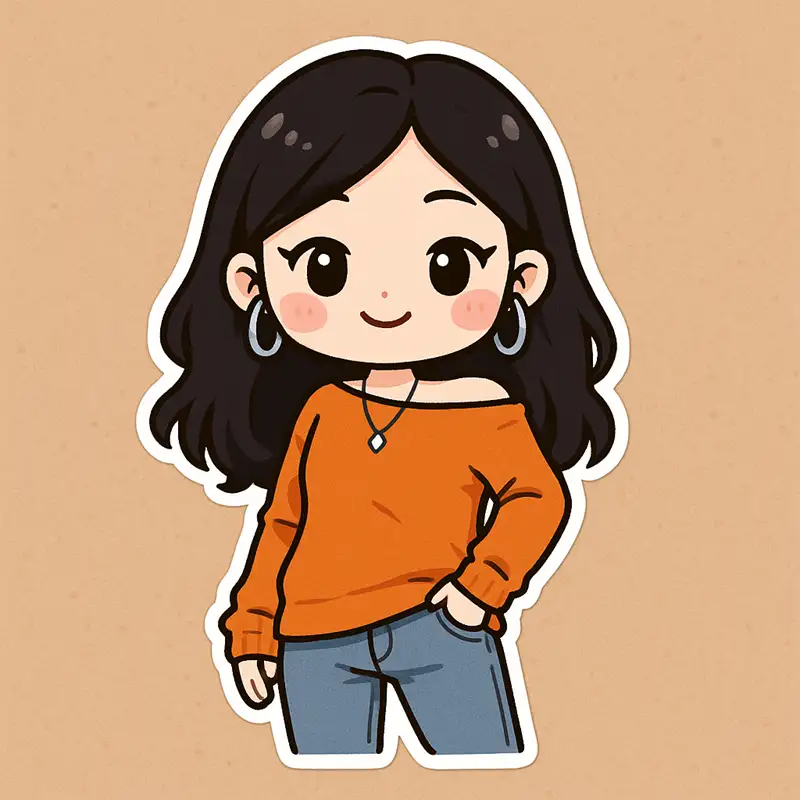
- What is chibi? — Chibi is not a genre and not a drawing mistake. It is a proportion system: the head is drawn far larger than the body, and everything else is simplified to match.
- What does "chibi" mean? — The word means "small" or "runty" in Japanese slang. In art it became the name of a proportion style, and in fandom it became a term of endearment.
- Chibi vs Q-style art — They are the same proportion system, named in two languages. The differences are in connotation, market, and what each term pulls up when you search.
- Why is chibi art so popular? — Four reasons, and only the first one is about cuteness. The other three are practical: it survives small sizes, it is cheap to produce, and it travels well between formats.
- How to draw chibi hair — The single biggest improvement in chibi hair is refusing to draw individual strands. Treat hair as three to five solid shapes that sit on top of the skull.
- How to draw chibi eyes — Everyone knows chibi eyes are large. What actually defines the look is where they sit: on the lower half of the head, with a wide gap between them.
- How to draw a chibi body — Once the head is set, the body is three simplified shapes. The difficulty is not the shapes, it is keeping them in the right proportion to a very large head.
- How to draw chibi legs — Chibi legs are short and tapered, and the feet are wedges. The real skill is balance: a big head makes any mistake in the stance obvious.
- How to draw chibi animals — The head carries everything. Pick three features that identify the species, exaggerate those, and let the rest of the body become generic.
- Chibi poses guide — A good chibi pose is legible as a solid black shape. Everything in this guide serves that one test.
- 3D chibi: the complete guide — A 3D-looking chibi is not a model file. It is an image where light and material do the structural work that a pencil line would normally do — and that has consequences for how you make it and how you size it.
- Pixar-look chibi: the complete guide — Soft light, real materials, no line. This register is defined by a handful of decisions, and it is the least forgiving of the chibi styles because there is no outline to hide mistakes behind.
- Watercolor chibi: the complete guide — The softest of the chibi registers, and the one that depends most on its edges — the place where the paint stops is the whole style.
- Minimalist chibi: the complete guide — Minimalism in chibi is not "less detail". It is a decision about which single feature carries the character — and then refusing to add anything else.
- Pencil sketch chibi: the complete guide — A pencil chibi is built from marks rather than light. That single fact drives every practical decision — including how large you have to render it.
- Anime chibi: the complete guide — The default. If someone says "chibi" without qualifying it, this is usually what they mean: bold line, flat or cel-shaded colour, and eyes carrying most of the expression.
Style comparisons
- 2D vs cartoon chibi — These two words get used as if they were opposites. They are not: 2D is about construction, cartoon is about register, and one image can be both, either, or neither.
- 3D vs resin kit chibi — One is pixels, the other is polyurethane. The confusion is common because both look like a figurine — and the practical answer depends on whether you want a picture or a thing.
- Cartoon vs Pixar-style chibi — Same proportions, different physics. The cartoon one is drawn; the Pixar-like one is lit. Everything else follows from that.
- Anime vs realistic chibi — The proportions are fixed by the style. What varies is how much realistic rendering is poured into those proportions — and that choice changes who the artwork is for.
- Pencil sketch vs 3D chibi — One is drawn with a tool that can only make marks. The other is lit by a light source that does not exist. Both can be beautiful, and they fail in opposite conditions.
- Soft-painted vs felt chibi — Two styles that are often described as "warm". One gets there through paint softness, the other through physical craft texture.
Turn a guide into an image
A style preset encodes the proportions, so you do not have to describe them in a prompt. Browse the 312 presets, or go straight to the workbench.
Frequently asked questions
Are these guides free?
Yes, and so is the tool they link to. The free plan includes one image credit a month with no watermark, and every plan carries commercial rights.
Do I need to be able to draw?
No. The drawing guides are for people who want to; the style guides and the presets are for people who would rather describe what they want and let the model render it.
How do I pick a style for my project?
Start from where the image will live. Small and flat (emotes, icons) wants anime or minimalist; large and printed wants painted or realistic; a sense of physical object wants the 3D-look register.